Data centre infrastructure has traditionally been managed through two distinct technology domains. Operational Technology (OT), encompassing BMS controllers, CRAH units, power distribution monitoring and environmental sensors, operates on protocols like BACnet and Modbus over dedicated, air-gapped networks. Information Technology (IT), including cloud platforms, analytics tools, DCIM software and enterprise systems, operates on standard IP networks with RESTful APIs, databases and web interfaces. Bridging these two domains is one of the most important challenges in modern data centre management.
The OT/IT Gap
In many data centres, the BMS and facility monitoring systems operate in isolation from the IT infrastructure they support. Environmental data stays locked in the BMS, accessible only through proprietary interfaces. Power data from energy meters requires manual extraction for PUE reporting. Capacity planning relies on spreadsheets rather than real-time analytics. This disconnect creates several problems.
Delayed response is a common issue. Environmental excursions or power anomalies detected by the BMS may not reach the IT operations team until the situation has already impacted equipment or services.
Manual reporting adds further inefficiency. PUE calculations, capacity reports and compliance documentation require manual data gathering from multiple systems, consuming engineering time and introducing errors.
Limited analytics capability is another consequence. Without a unified data platform, operators cannot correlate IT workload changes with facility performance, identify optimisation opportunities across domains, or apply machine learning and advanced analytics to operational data.
Vendor lock-in compounds these challenges. Proprietary BMS platforms with closed data models make it difficult to integrate with modern cloud and analytics tools, limiting the organisation's ability to leverage new technologies.
The MQTT Bridge
MQTT (Message Queuing Telemetry Transport) has emerged as the preferred protocol for bridging OT and IT in building and data centre environments. Originally developed for IoT applications, MQTT provides a lightweight, publish-subscribe messaging framework that is well-suited to transporting real-time telemetry data from field devices to cloud platforms.
MQTT brings several advantages for OT/IT convergence. It is lightweight and efficient, with minimal overhead that makes it suitable for high-frequency sensor data from hundreds or thousands of measurement points. The publish-subscribe model decouples data producers (sensors, meters, controllers) from data consumers (dashboards, analytics, DCIM), enabling multiple systems to consume the same data stream without point-to-point integration. Quality of Service levels at QoS 0, 1 and 2 provide flexibility to match delivery guarantees to the criticality of each data stream. It is an open standard supported by virtually every cloud platform including AWS IoT, Azure IoT Hub and Google Cloud IoT, as well as leading analytics tools and DCIM platforms. TLS encryption provides secure transport that protects sensitive operational data in transit.
The Sync Edge Gateway Approach
The Sync Edge Gateway is purpose-built to bridge OT and IT in data centre and building environments. Deployed at the facility level, it connects to existing BACnet and Modbus field devices on the OT network and publishes normalised, structured data to MQTT brokers accessible by IT systems.
The gateway performs several critical functions. For protocol translation, it reads data from BACnet IP, BACnet MS/TP, Modbus RTU and Modbus TCP devices and translates it into structured MQTT messages with consistent topic hierarchies and JSON payloads. Edge processing performs local data aggregation, filtering and threshold monitoring before transmitting to the cloud, reducing bandwidth requirements, enabling local alerting for critical conditions and ensuring continued operation if the cloud connection is interrupted. Data normalisation converts disparate data formats from different equipment vendors into a unified data model, eliminating the need for each consuming system to understand the specifics of every field device. All data is transmitted over TLS-encrypted MQTT connections with certificate-based authentication, meeting cybersecurity requirements for data centre environments.
Architecture Pattern
A typical OT/IT bridge architecture for a data centre facility consists of three layers.
At the Field Layer (OT), Distech Controls ECLYPSE controllers manage HVAC systems, SM5000 monitors provide rack-level environmental data, and Janitza UMG meters measure power at PDU and switchboard level. These devices communicate via BACnet IP, Modbus TCP and native MQTT on the dedicated OT network.
At the Edge Layer, Sync Edge Gateways aggregate data from all field devices, perform local processing and publish structured MQTT messages to the central broker. The gateway sits at the boundary between the OT and IT networks, with appropriate network segmentation and firewall rules.
At the Platform Layer (IT), the Sync DCiM Platform, cloud analytics tools, enterprise dashboards and third-party DCIM systems subscribe to MQTT topics and consume the normalised data stream. Each system receives the same real-time data without requiring direct access to the OT network.
This architecture provides several benefits. Security is maintained because the OT network remains segmented, with the Edge Gateway acting as a controlled, one-way data bridge. Scalability is straightforward since adding new consumers such as dashboards, analytics or DCIM systems requires only an MQTT subscription rather than additional field integration. Resilience is built in through edge processing that ensures local alerting and data buffering even during cloud connectivity interruptions. And the architecture offers flexibility because the publish-subscribe model allows new analytics and AI capabilities to be added without modifying the field infrastructure.
Real-World Impact
Data centre operators who have implemented OT/IT convergence through this architecture report significant improvements. Automated PUE and capacity reporting replaces hours of manual data gathering. Real-time environmental and power data reaches operations teams in seconds rather than minutes. Unified data enables correlation of IT workload with facility performance for informed decision making. And the MQTT-based architecture supports emerging use cases including AI-driven optimisation, digital twins and predictive maintenance.
Conclusion
The convergence of OT and IT in data centre infrastructure management is no longer optional. As facilities become more complex, as regulatory and sustainability requirements intensify, and as customers demand greater transparency, the ability to bring operational data into modern analytics and management platforms is essential. An MQTT-based edge gateway architecture provides a secure, scalable and standards-based path to bridging this gap, unlocking the full value of data centre operational data.
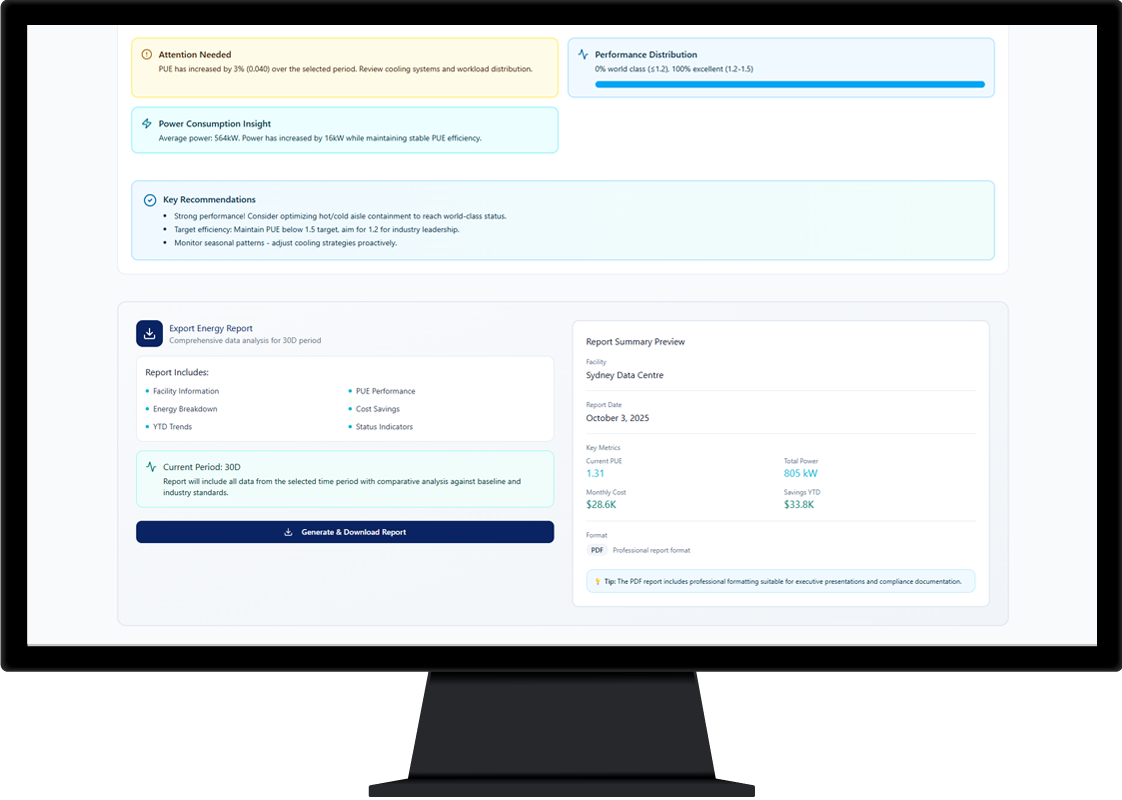
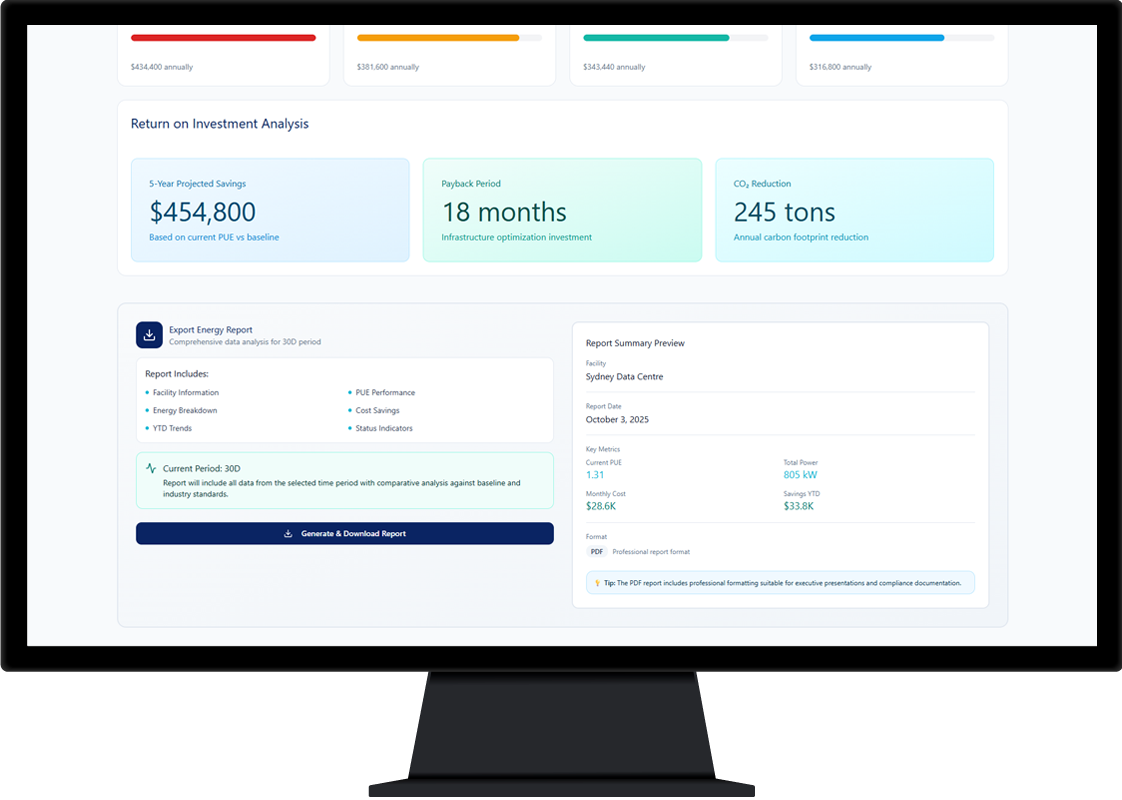
Platform Dashboard Examples