For decades, data centre environmental monitoring has relied on sensors installed at Computer Room Air Handler (CRAH) units. Return air temperature, supply air temperature and relative humidity measured at the CRAH provide a general indication of conditions in the data hall. But as rack densities increase, mixed-density environments become the norm and SLA requirements tighten, CRAH-level monitoring is no longer sufficient.
The Limitations of CRAH-Level Monitoring
A typical CRAH unit serves a large zone of the data hall, often covering 20-50 racks or more. The return air temperature measured at the CRAH is an average of all the air returning from this zone, blending hot exhaust air from high-density racks with cooler air from underutilised areas. This averaging effect masks critical information.
Hidden hot spots are one of the biggest risks. A rack drawing 15 kW in a zone of 5 kW racks may have inlet temperatures exceeding 35 degrees C, well above ASHRAE recommended limits, while the CRAH return air sensor reads a comfortable 28 degrees C. The hot spot is invisible to the monitoring system until equipment fails.
Overcooling waste is equally problematic. To protect against potential hot spots that CRAH sensors cannot see, operators typically set conservative supply air temperatures and run fans at higher speeds than necessary. This results in significant overcooling in large portions of the data hall, wasting energy and reducing PUE.
Airflow bypass and recirculation compound these issues further. Without rack-level visibility, operators cannot identify areas where conditioned air is bypassing server inlets (going directly from supply to return without performing useful cooling) or where hot exhaust air is recirculating back to server inlets. Both conditions degrade cooling effectiveness and increase energy consumption.
The Case for Rack-Level Monitoring
Rack-level monitoring addresses these limitations by providing environmental data at the point that matters most: the server inlet. By measuring temperature and humidity at multiple heights on each rack (typically bottom, middle and top), operators gain a complete picture of thermal conditions across the entire data hall.
What Rack-Level Data Reveals
Real-time thermal mapping gives operators a rack-by-rack view showing exactly where conditions are optimal, where hot spots exist and where overcooling is occurring. This information is immediately actionable.
Inlet versus exhaust temperature differentials reveal the heat removal effectiveness for each specific location. A rack with a small temperature differential may indicate airflow bypass, while an unusually large differential may signal insufficient airflow.
Vertical temperature stratification is another important factor. Temperature often varies significantly from the bottom to the top of a rack, particularly in environments without proper containment. Rack-level sensors at multiple heights capture this stratification, enabling targeted remediation.
Localised humidity conditions can also differ significantly from CRAH readings, particularly near perimeter walls, loading docks or areas with recent construction activity. Rack-level humidity sensors provide early warning of conditions that could cause condensation or electrostatic discharge.
The SM5000 Approach
The Synchronous SM5000 Multi-Sensor Data Acquisition Controller is purpose-built for rack-level data centre monitoring. Each SM5000 unit connects to multiple TH-485 temperature and humidity probes positioned at rack inlet and exhaust locations, providing granular environmental data via MQTT and Modbus TCP.
Each SM5000 supports multiple sensor inputs, enabling inlet and exhaust monitoring at multiple rack heights from a single controller. Data is available simultaneously via MQTT for cloud and analytics platforms and Modbus TCP for integration with existing BMS and DCIM systems. The units are PoE powered using 802.3af Power over Ethernet, which eliminates the need for dedicated power supplies at each rack and simplifies installation. Onboard processing enables local threshold monitoring and alerting, ensuring critical alarms are generated even if the network connection to the central platform is temporarily interrupted. A built-in OLED display provides at-a-glance readings for technicians during physical rack inspections.
Integrating Rack-Level Data with Cooling Control
The true value of rack-level monitoring is realised when sensor data is integrated into closed-loop cooling control strategies. Distech Controls ECLYPSE controllers managing CRAH units can use real-time feedback from SM5000 sensors to adjust fan speeds based on actual rack inlet temperatures rather than CRAH return air averages. They can modulate chilled water valves in response to zone-specific cooling demand and rebalance airflow across multiple CRAH units serving the same zone to eliminate hot spots without overcooling adjacent areas. This also enables demand-based cooling that responds in real time to changes in IT load, rather than running at fixed speeds for worst-case conditions.
This closed-loop approach typically delivers 15-25% cooling energy savings compared to traditional fixed-setpoint operation, while simultaneously improving environmental consistency and reducing the risk of thermal events.
Making the Business Case
The return on investment for rack-level monitoring is driven by three factors. First, energy savings from eliminating overcooling and enabling demand-based CRAH control reduces cooling energy consumption by 15-25%. Second, capacity recovery through identifying and eliminating hot spots and airflow inefficiencies recovers stranded cooling capacity, deferring or avoiding capital expenditure on additional cooling infrastructure. Third, risk reduction from proactive hot spot detection prevents equipment failures and SLA breaches that can cost far more than the monitoring infrastructure itself.
For a facility with $1 million in annual cooling costs, a 20% reduction pays for a comprehensive SM5000 deployment in under 12 months.
Conclusion
As rack densities increase and data centre operators face pressure to improve efficiency while maintaining reliability, CRAH-level monitoring alone can no longer provide the visibility needed to operate effectively. Rack-level environmental monitoring with the SM5000 delivers the granularity that modern data centres demand, enabling precision cooling control, proactive risk management and measurable PUE improvement.
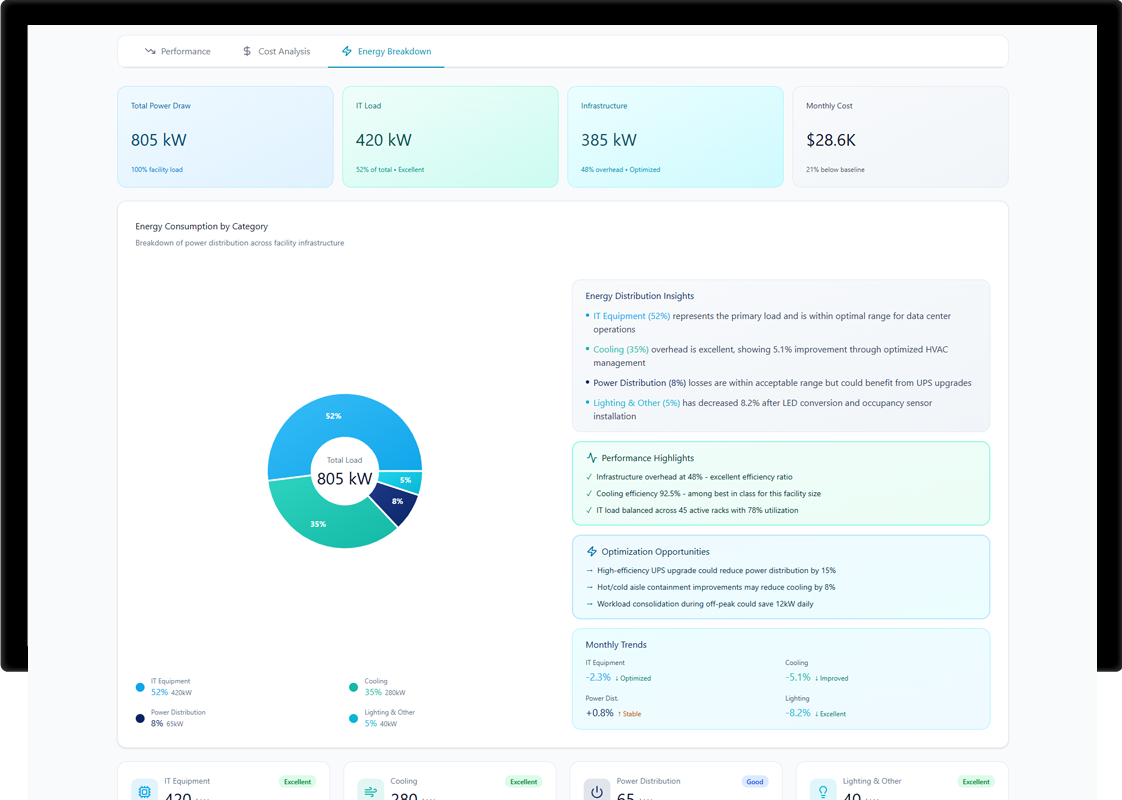
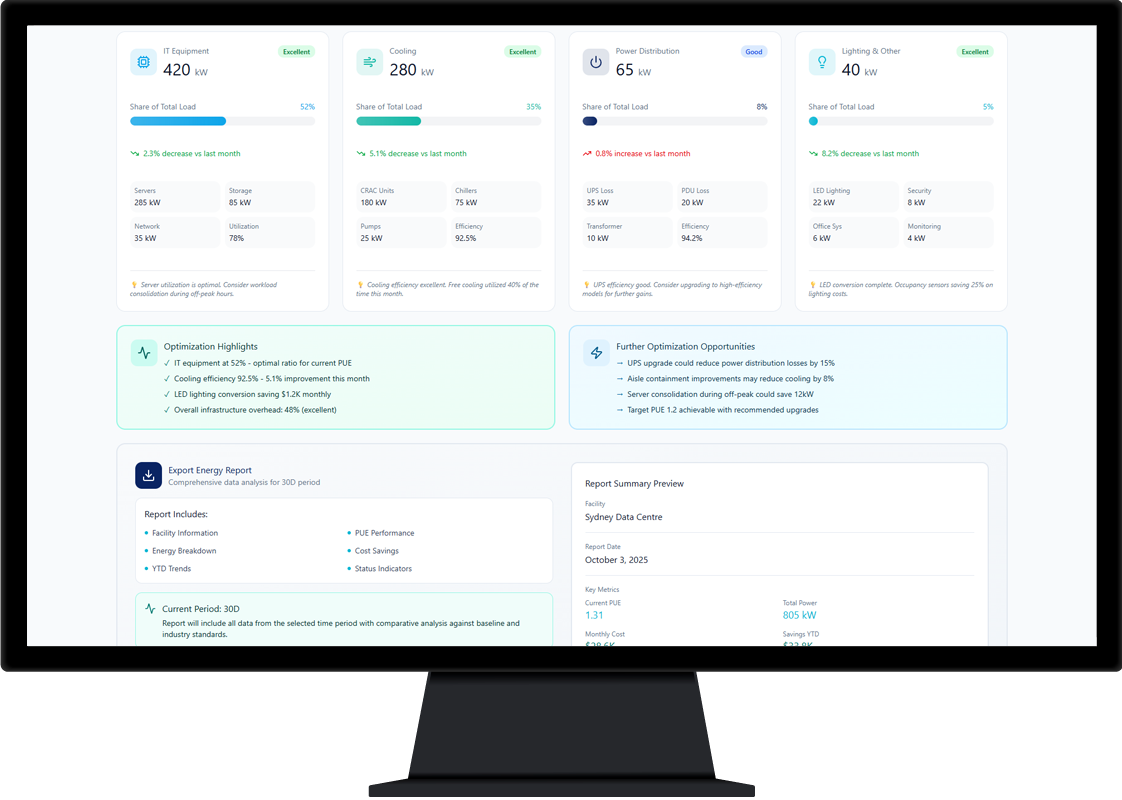
Platform Dashboard Examples